Vote
Vote
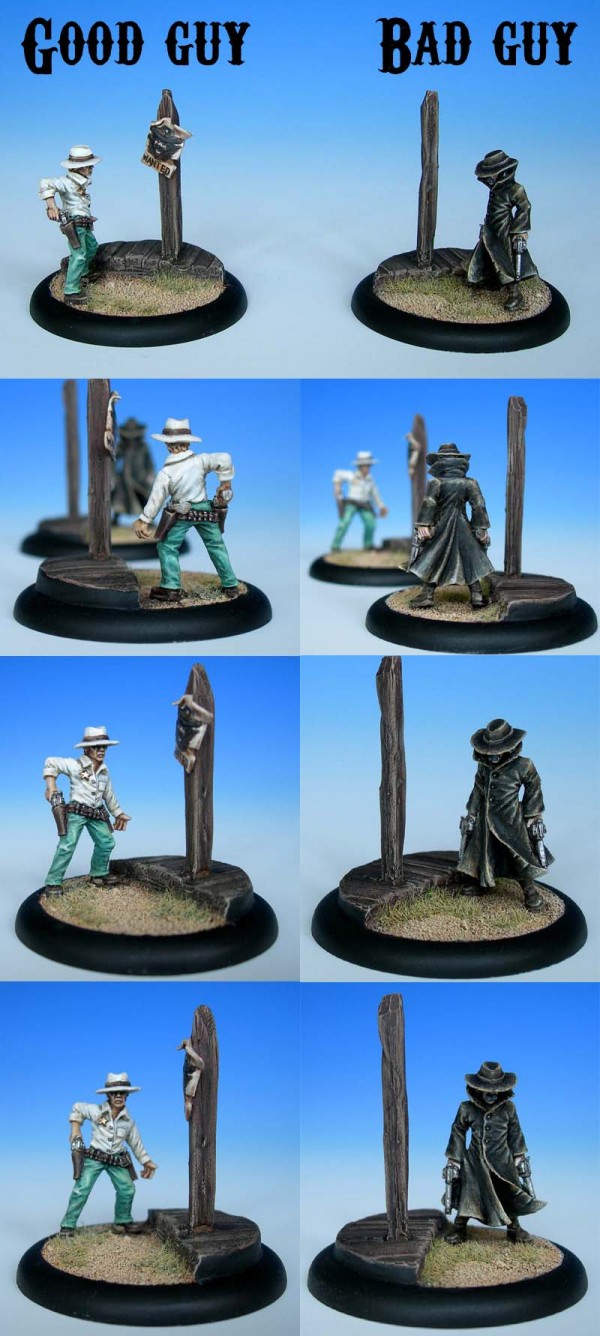
Good guy - Bad guy
Couple of things to talk about here. First of, thanks to everyone over at Wyrd-game.net for the comments and critiques. (http://www.wyrd-games.net/gallery/showimage.php?i=820&c=32) This piece started out two days before the deadline on the "Total Testosterone 2" competition. I was pressed for time so wanted to do something simple. I brought out the bag of Tombstone cowboys, intending to paint the trenchcoat guy as a single miniature. He fits the masculine stereotype of a wild west desperado perfectly, and was an easy choice considering the theme of the competition. With the miniatures thus laid out before me, I realised the model had a natural interaction with another of the cowboys, the one that became the sheriff in the finished piece. I then divided the two characters on two bases rather than a single base for a number of reasons. (This is where I go of ranting artistic intentions - more practical talk about the piece later) Mainly this is a comment on miniature photography. It is intended to raise questions regarding the experience of showcasing the 2D image as a finished product, especially given the context of evaluation as presented on a site like CMON. The two miniatures can be split up, and presented individually. But integrating them together in a photographic collage is an attempt to take the 2D effect of a 3D artwork and project it onward into a 4th dimensional affect. Without you, this diorama does not exist. The implication of the two miniatures is controlled by the artificial context into which I have placed them - the photographic collage & the insistence that the title is part of the artwork. These characters are not so much trying to outshoot each other. They are outlined by individual frames (bases), and frozen in a pose (this can be said of all miniature, I guess). The frame contains the character, and refrains from explaining the world surrounding him. Between the two constricting frames exists the concept of negative space (all the things not being shown, the passing of time etc.) Through the not explaining these details, the intensity, immediacy and presence of the scene is made immediately apparent, and recognisable as an established image, the wild west shootout. Thus creating the 4th dimension, as mentioned above. It could be argued that they are infact each both a good guy and a bad guy, reflections of the same masculine stereotype - and please note that I am thinking here more of Aristoteles dramatic stereotypes, than a prejudiced masculine stereotype. ----------------------------------------------------------------------------------------------------- Back to talking about practical miniature painting again.. The bases are made from modelling putty, and I tried to place the two pillars in a way that suggested a geographical closeness between the characters, and at the same time functioned as a solid compositional devise when the models are seen individually. When viewed from above, the miniature is divided by thirds into a classically balanced composition. I tried working in a reverse highlighting technique, starting with the lightest colours and using glazes to shade down the colours, then gradually applying the highlights back towards the edges. Espescially on the black coat, this provides a very effective worn look. I worked in various warm and cold shades in between glazes and as a final touch. I mainly used Vallejo acrylics on this piece, to get a matt finish. The metallics are the only exception to this, being painted in enemals. Finally, a big thanks to Jakob Nielsen for letting me borrow his photosetup. It made all the differense in presenting this scene.
Posted: 2 Jul 2006


3 comments
More by Sonny