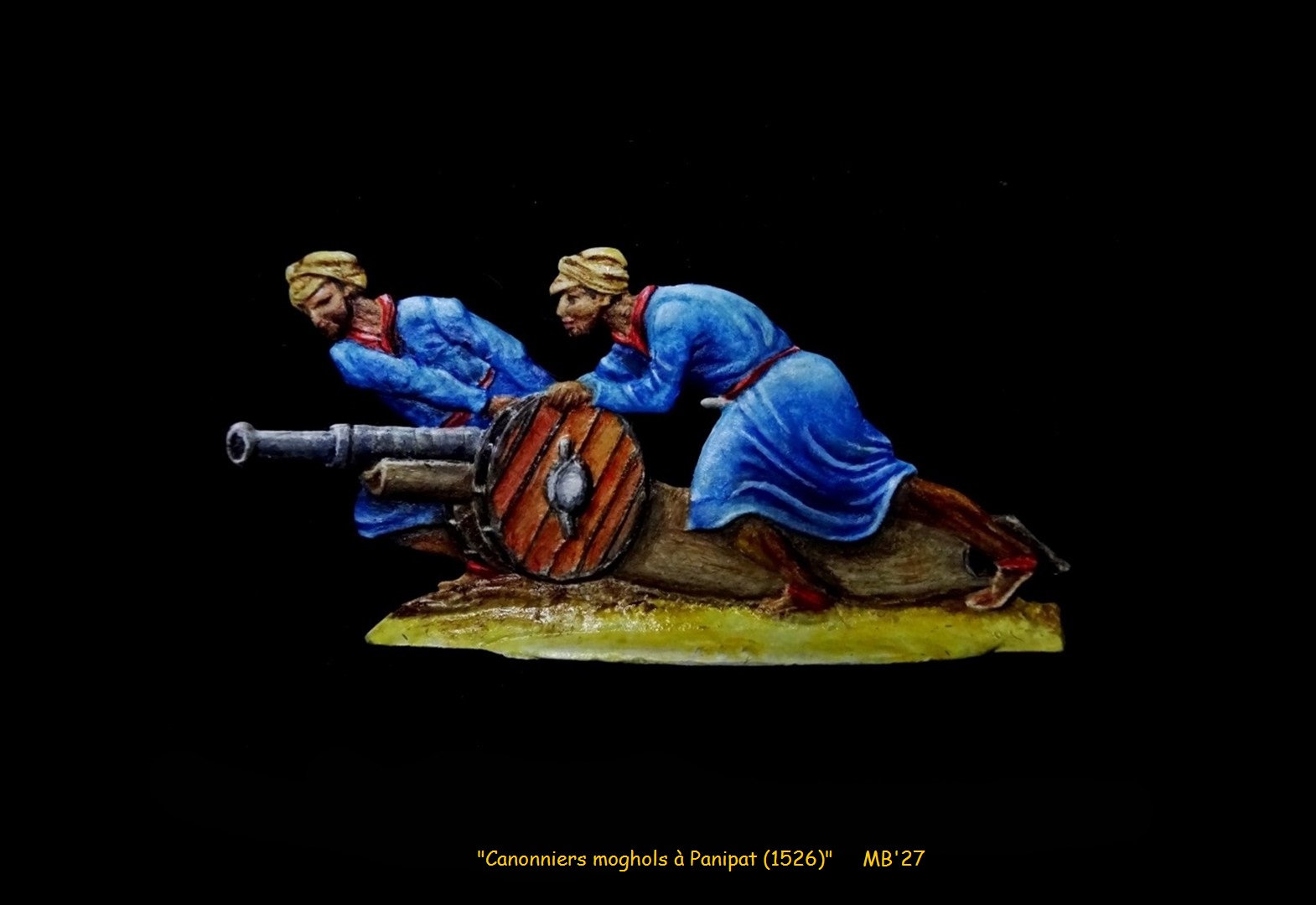
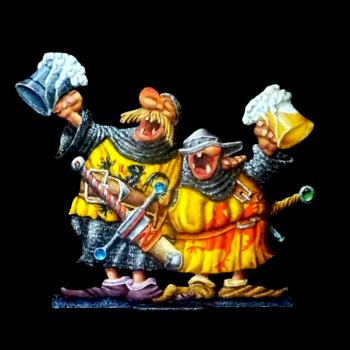
Thank you both of you, happy you do appreciate flats and their painting using widely the 'trompe-l'oeil' technique, with shadows and lights, much easier in the figurines world. This one is a one piece set, about 20mm high. There are other sites showing flats; I shall post a few more in the coming weeks. They cover mostly history and fantasy, less fantastic worlds and unrealistic imagination.
Zahir-ud-din Muhammad Babur (1483 – 1530; Baber or Babar) was a conqueror from Central Asia who, following a series of setbacks, finally succeeded in laying the basis for the Mughal dynasty in the Indian Subcontinent and became the first Mughal emperor. He was a direct descendant of Timur, through his father, and a descendant of Genghis Khan through his mother. Culturally, he was greatly influenced by the Persian culture and this affected both his own actions and those of his successors, giving rise to a significant expansion of the Persianate ethos in the Indian subcontinent.
By the early 16th century the Muslim sultans of Delhi (an Afghan dynasty known as Lodi) are much weakened by threats from rebel Muslim principalities and from a Hindu coalition of Rajput rulers. When Babur leads an army through the mountain passes, from his stronghold at Kabul, he at first meets little opposition in the plains of north India.
The decisive battle against Ibrahim, the Lodi sultan, comes on the plain of Panipat in April 1526. Babur is heavily outnumbered (with perhaps 25,000 troops in the field against 100,000 men and 1000 elephants), but his tactics win the day.
Babur digs into a prepared position, copied (he says) from the Turks - from whom the use of guns has spread to the Persians and now to Babur. As yet the Indians of Delhi have no artillery or muskets. Babur has only a few, but he uses them to great advantage. He collects 700 carts to form a barricade (a device pioneered by the Hussites of Bohemia a century earlier).
Sheltered behind the carts, Babur's gunners can go through the laborious business of firing their matchlocks - but only at an enemy charging their position. It takes Babur some days to tempt the Indians into doing this. When they do so, they succumb to slow gunfire from the front and to a hail of arrows from Babur's cavalry charging on each flank.
Victory at Panipat brings Babur the cities of Delhi and Agra, with much booty in treasure and jewels. But he faces a stronger challenge from the confederation of Rajputs who had themselves been on the verge of attacking Ibrahim Lodi.
The armies meet at Khanua in March 1527 and again, using similar tactics, Babur wins. For the next three years Babur roams around with his army, extending his territory to cover most of north India - and all the while recording in his diary his fascination with this exotic world which he has conquered.
How nice to see some historical flats here! And what an unusual subject! I would love to know more about the background.
As for the paint job, that is a nice piece of work with the oil colors. It is really hard to make a single flat with multiple figures and a cannon look plastic, but you pulled it off. I especially like the light on the gun barrel and the vivid wood colors on the wheel. Thanks for sharing!

 Vote
Vote