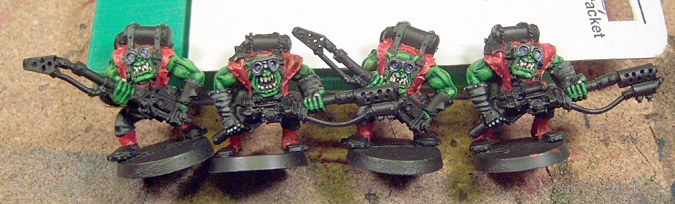
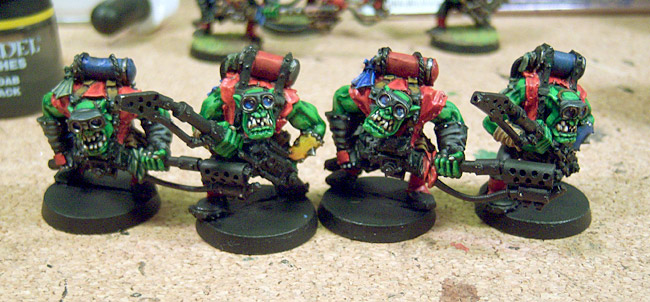
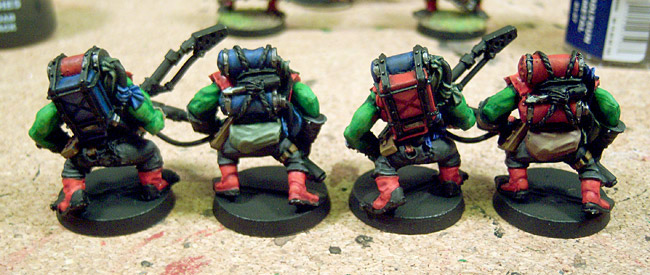
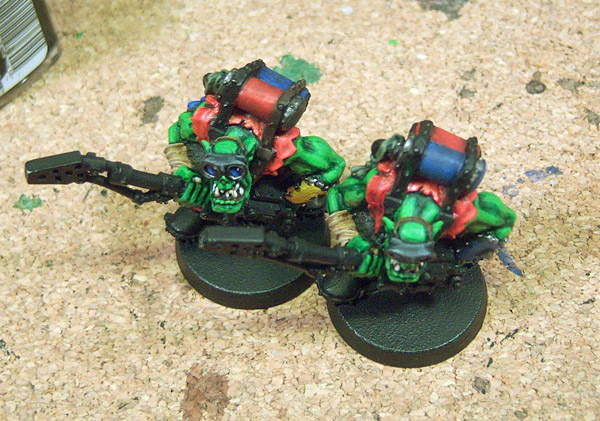
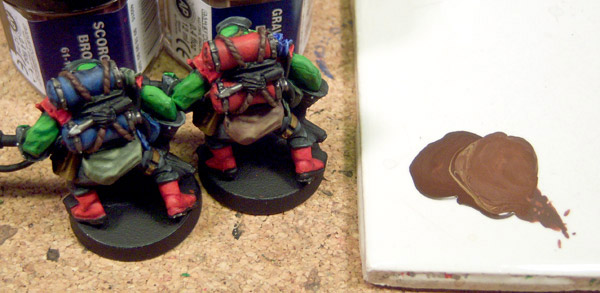
Thanks Prophecy07. I'll quote myself with what I told another daunted ork player/painter on another forum...
"Painting minis in general can be difficult - and the possible size of the ork forces can make it extra daunting. For a bit of perspective, I've been working on this army since 2002 so it's a looong work in progress! I keep in mind that every time I finish a unit, it's another one done and I get (yet "get") to move on to the next one!
Also - if you're looking to be a better painter, the best way is through practice, practice, practice! (I know it sounds cliche, but it's terribly true)."
OK - Here's the tutorial for how I do my leather straps - nothing super fancy, pretty much the usual. I originally got this from the internets so I'm just showing you how someone else did it.
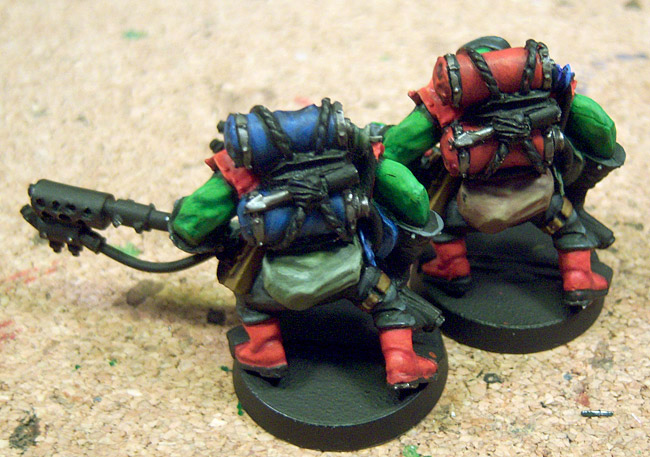
I started by cleaning up the straps, making them all black and trying my best to separate them out from the surrounding areas.
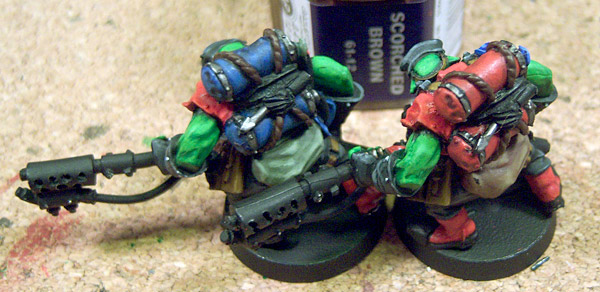
I'm showing you photos really close up so you'll see how messy it can be close up. I paint my "regular joes" to just a high tabletop and you can see the messiness of the work in these photos. More steps and thinner paint makes for a smoother transition and cleaner paintjobs - I reserve that for the special characters and bosses.
On to the ugliness!
The first step is
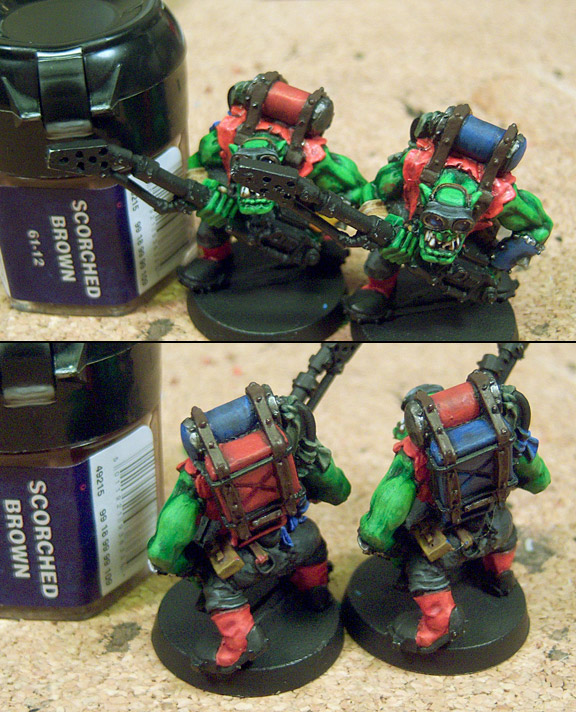
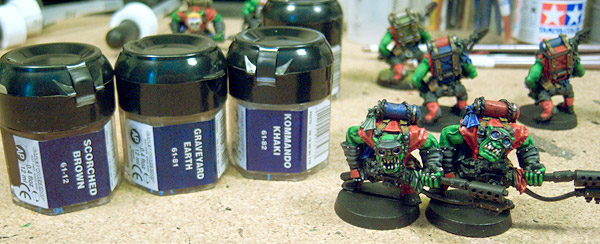
Scorched Brown. This is laid down evenly across the entire strap. Since this color is already so dark I don't feel the need to leave any black at the edges of the strap or the rivets/studs.
Step two (or three after clean up) is
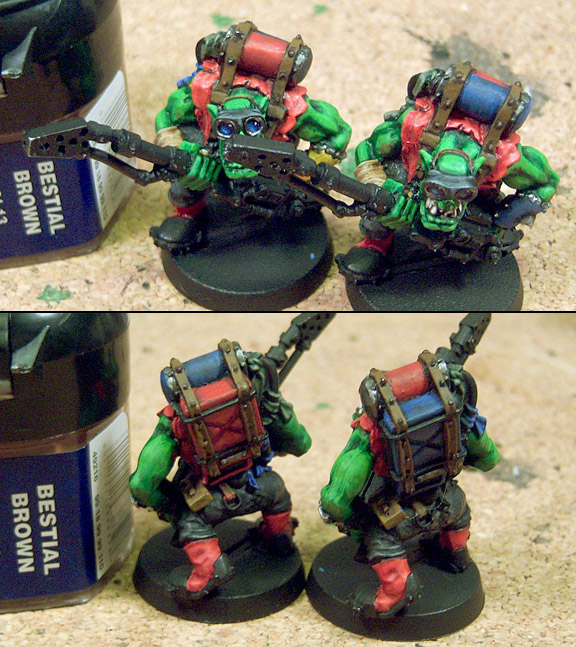
Bestial Brown. This is used to give a base color to the straps and define the actual outline or edges of the straps.This is where I start pulling back and leaving some of the Scorched Brown showing to give definition to the separate areas. I do this in two or three thin coats, building up more paint in the higher areas and more open spaces such as between the rivets/studs.
The next step (and final for the actual leather areas) is
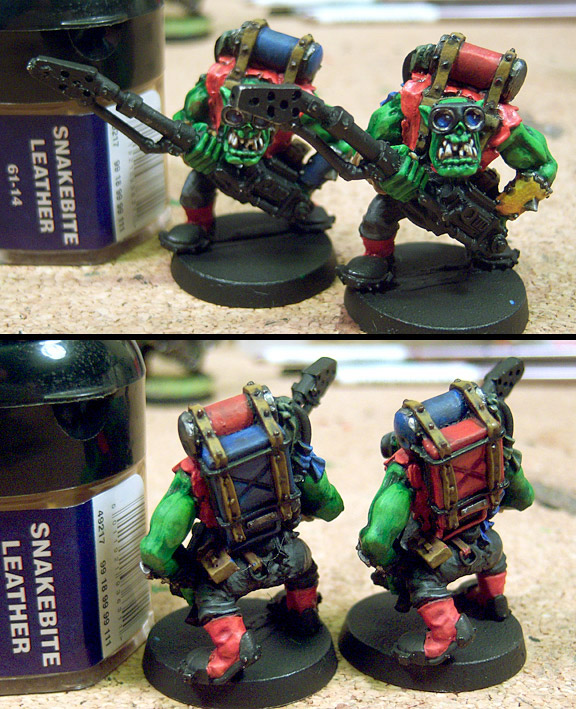
Snakebite Leather. This is layered much like the previous Bestial Brown. A few thinner layers with more layers applied on the highest spots and also giving the sharp edge a little highlight for a little extra definition.
It all doesn't look like much while going on but building up these layers from dark becomes second nature after a while and really makes for some smooth and more natural transitions.
I did the studs in a quick and dirty NMM style using
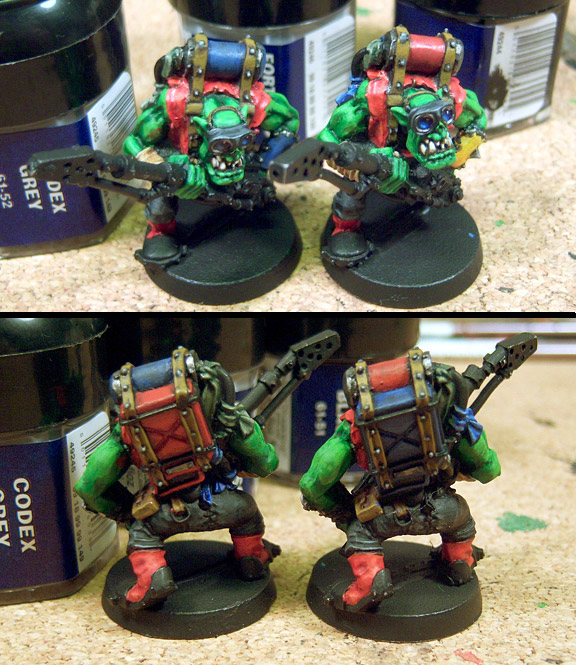
Chaos Black to re-dot the studs (I'm kinda messy remember?), then a dot of
Chaos Black mixed 50/50 with
Codex Grey. A spot of straight
Codex Grey on that with a highlight of
Fortress Grey for reflection.
Now, in all reality, I didn't get a really got coat of those colors in the perfect places, I'm not anywhere near that good. What it does do is give preceding layers something to sit on and sometimes it works out. The ones that don't? Say something like "Orks aren't perfect and they're supposed to be beat up and dirty" or "It's for variation. We don't want them all the same, do we?" Yeah, that's it! The point being, for high-tabletop standard, it's pretty good.
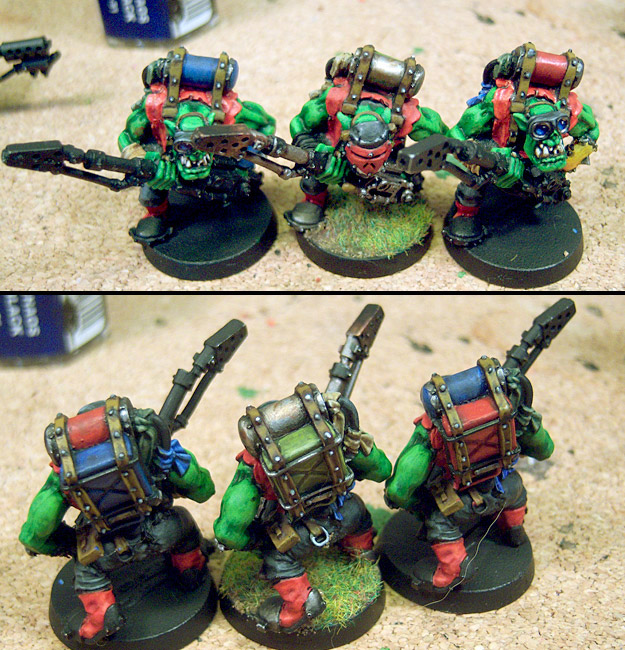
I also have one last trick up my sleeve and that the knowledge that the final varnish (I use Testors Dulcote) will defuse the light enough to smooth the trasitions all over the model. Here's what that difference looks like.
The middle burna has been sealed already, notice the colors a bit muted (a side effect of the Dulcote - I highlight one step higher to negate this for the finished product) and the straps/studs are a little smoother than the boyz unfinished.
I hope this helps anyone (especially you DocNuk!) and I'm more than happy to show people how I do things, I like to teach - at least those willing to learn!
Later today I'll show you how I did the ropes holding down the dual tank burnas.
Later!