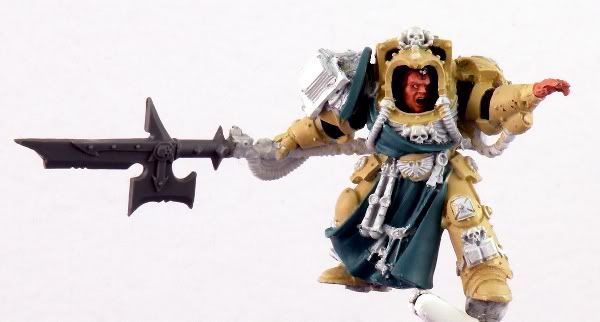
Originally posted by redarmy27
Thanks for the feedback DR!
I was thinking of maybe switching into manual mode with my camera because I can fully adjust the \"F\" setting as well as the ISO to a ridiculously nice number (my Nikon can go from 8\" all the way up to 1/3200) so I have complete control over my settings. Then it\'s just a matter of trying to find that good spot for my camera.
For want of a better description ISO is the sensitivity of the Film. The lower the number the higher the quality. Which is why a lot of photographers used to used Kodachrome 25 slide film. (ASA {now ISO 25})
The 8\" to 1/3200 you refer to sounds more like Shutter speed and at 1/3200 you\'ll need a lot of light for best depth of field.
Most fixed body lenses are designed to work at their best in \"normal\" situations, whereas our hobby uses the lens in a less than normal manner.
As I recall (?)standard lenses often work best at closer (macro) mode ranges when set to F11 or F16. Now this will mean that your Depth of Field of Apparent Focus will still seem sharp and you should get the best results around that.
Ok Now for a complex bit:
Depth of Field of Apparent Focus (DOF)is a \"trick\" of the lens and the aperture combined.
In truth there can only be ONE point of focus, so what happens is that the focal point is sharp and the areas in front and behind it look sharp (as a rough rule of thumb 1/3 in front and 2/3 behind the point of focus.) Like So:
[size=-2]out of focus[/size] ...
..|...........[size=-2]out of focus[/size]
So it\'s trying to find the \"sweet spot\" on which your camera can focus and provide the best DOF.
Ideally the camera lens should be vertically parallel to the mini to prevent the plane of focus cutting through the mini at an angle ( [/b]/[/b]) and messing up the DOF.
Man that was complex to explain.

The review
HERE demonstrates the effect of \'Noise\' in the image at higher ISO settings. Now the P80\'s lowest ISO is 64 and I\'d suggest that you use that as a base starting point to work with.
If you want to do a test try setting up a row of paint pots so that the colours themselves are all visible and take few shots. That way you can see what the variation in the light metering/balance is and adjust accordingly in your favorite photo editing program.