A writer needs some firearms info

evil tendencies

Cake or Death?
airhead congratulations i voice of reason in a crazy world..

eviltendencies i must apologise for my contribution in hi jacking your your thread give us a nudge in the original direction, maybe some fluff on your character, is it a hit man type, james bond or something like wanted i know im interested in hearing more.:starving:

Kinda bummed some of you guys are getting upset about this. There is no reason to keep this a personal thing - I'm actually learning a heckuva lot, all of which I can use. I'm imagining that my character would have some of these arguments with his colleagues, and so getting familiar with the debate is really useful. So, then, my shooter...he uses .22LR in his concealed weapon for a number of reasons. The size of the weapon's frame is important, and he prefers a bigger magazine capacity to a small capacity with a bigger caliber. The availability of the ammo is important too. Here in Cali, come 2011, we will only be able to buy 50 rounds of pistol ammo a month; pistols that fire rifle ammo won't require him to smuggle ammo from Nevada or some such, which his sense of lawfulness would object to. His flaws also contribute to this decision. The price of .22LR is lower, and, to put it bluntly, my character is a bit cheap, so it has monetary appeal. He's the kind of guy who will machine a weapon, or parts of it, to save twenty bucks, and his approach to ammo is similar. There is also a pride issue involved. He likes to think of himself as an elite shooter (and in many ways, he is), and it strokes his ego to believe that he can handle anything with a small gun and accurate shooting, much like the Mossad guys are famous for. The tension in this character comes from the fact that his skills are good enough to support his quirks, but not always. Thanks for your help, folks; I'll keep reading anything you have.
 
Last edited:

Rodnik

New member
"Goddard amply proves the fallacy of 'knock-down power' by calculating the heights (and resultant velocities) from which a one pound weight and a ten pound weight must be dropped to equal the momentum of 9mm and .45ACP projectiles at muzzle velocities, respectively. The results are revealing. In order to equal the impact of a 9mm bullet at its muzzle velocity, a one pound weight must be dropped from a height of 5.96 feet, achieving a velocity of 19.6 fps. To equal the impact of a .45ACP bullet, the one pound weight needs a velocity of 27.1 fps and must be dropped from a height of 11.4 feet. A ten pound weight equals the impact of a 9mm bullet when dropped from a height of 0.72 inches (velocity attained is 1.96 fps), and equals the impact of a .45 when dropped from 1.37 inches (achieving a velocity of 2.71 fps).

A bullet simply cannot knock a man down. If it had the energy to do so, then equal energy would be applied against the shooter and he too would be knocked down. This is simple physics, and has been known for hundreds of years. The amount of energy deposited in the body by a bullet is approximately equivalent to being hit with a baseball."

I'm curious about the experiment. When they say "equals the impact", what does that mean? Are we talking the same force per square inch?
 

DannyBoy2k

New member
Why is my formatting screwed up, and why can't I edit?

Probably because someone else has managed to write so you're not the last any more.

As an aside for the .22, one of the nice things about it is the minimal amount of recoil, allowing you to more or less empty the gun without having to shift it. 8-10 rounds of .22 fired as quickly as you can pull the trigger will make most people rather upset, even if you DON'T have the great aim. Basically point and click, as it were. Now, would that be lethal? No, perhaps not. But usually, a back-up piece is for 'get the fuck away from me!' And no matter what, no-one is going to start anything with 10 holes in them. They have more pressing matters to attend to.

Also, if it is interesting/relevant, both the aforementioned SIG and Walther can be found with a threaded barrel, allowing for a silencer. And a silenced .22 is VERY silent. Especially if you hand-load, and can cold-load. Won't go too far, but the loudest noise would be the slide clicking. And if you use a slide-locker? Whisper-quiet. Of course, you'd only get the one shot, in that case, but still...
 

cassar

BALLSCRATCHER
good guy bad guy

1st i promise to behave its about time i acted my age and not my shoe size. must start taking the pills again.
2nd is the character good or bad or both like dexter and are there any specifics to these "situations" he gets into? come on give us a bit more of the meat n bones or do we have to wait till you publish:starving:
 

Einion

New member
While I do agree with you, in most cases, and certainly out of a purely...medical/mechanical? point of view, this isn't entirely a true statement. We DO know that knock-down happens.
But that's not due to the kinetic energy, which is the point I was addressing. Very important to make the distinction - a person killed outright by any projectile will be 'knocked down', i.e. they'll fall to the ground, but they weren't of course knocked over.

Even a hit from a broadhead arrow, which has a measly amount of impact energy compared to a bullet because of the low velocity, can of course cause an immediate knockdown but it needs to be made clear, for anyone that doesn't know, that the target was not knocked over by momentum transferred from the arrow.

So, knock-down do exist, and cops know that the larger the calibre, for some reason, the larger the chance.
Yes, because larger bullets create larger-diameter permanent wound cavities, which have a greater chance of hitting a vital structure (with a greater chance of damaging it badly or destroying it). And some large-calibre bullets will also tend to penetrate deeply, further improving the chance that the permanent wound cavity will transect something one can't function without.

And, we've certainly come a LONG way from the .22LR discussion, haven't we? :)
Indeedie. But misinformation should not be allowed to stand unchallenged. And the discussion is essentially related to the thread topic.

I'm curious about the experiment. When they say "equals the impact", what does that mean?
Momentum.


temporary cavity does not wound emm...
Reading other people's posts fully is a great start in a discussion: HANDGUN ROUNDS.

If you go back and check post #30 you'll see the first quote on the subject specifically mentions them. The thread's originally about handguns - so that can be assumed to be the context - but I was as careful as possible to make sure my responses were focused on this area as much as possible, as fascinating as the wounding characteristics of rifle rounds are.

really if you want to continue this thread you should create one yourself as this one 's supposed to be about a book character not the contents of your book collection.
Hey, facts are facts, if they don't support what one believes to be true then you deal. You don't try to shut down the opposition, that's just weak.


I'm actually learning a heckuva lot, all of which I can use.
Excellent. That's why I wouldn't let bad info stand.

The size of the weapon's frame is important, and he prefers a bigger magazine capacity to a small capacity with a bigger caliber.
That's the classic tradeoff that many people have debated in their heads to decide on their self-defence piece, if they have a choice, so that's dead on.

As you know, some people do go the other way, with a low-capacity .45 for example. .45 ACP is in many respects a brilliant anti-personnel round when fired from a handgun, but its overall ballistic performance (primarily the chance of overpenetration) cause some people to go a little lighter. It's all a balancing act, and there's no one right answer.

Lastly, a little more on something touched on previously. We know now the guy's a bit of a tightwad but specific ammunition types can make a substantial difference. So for .22 LR Remington Yellow Jackets or CCI Stingers might be the choice because of their high velocity, despite being a little more pricey.

Einion
 

airhead

Coffin Dodger / Keymaster
...Actually, no. A battle rifle uses the same calibre as a rifle. A battle rifle is a military weapon which fires rifle ammunition, and, more often than not, is capable of automatic or selective fire. The M14, for instance, or the Mosin Nagant.
An assault rifle, by and large, however, fires a smaller calibre rifle-type round, such as the 5.56/.223 or the Russian 5.45. Or, even, the Russian 7.62x39. There is, however, quite a bit of overlap here. There are a few weapons generally seen as assault rifles which fires the 7.62x51, which is normally seen as a battle rifle round. *picking nits*

Conceded... poor choice of words on my part.
I was thinking of the 5.56 as I was typing that.

****

Something I just realized... a few have made mention of loading their own. There is no non-commercial (home) reloading for rim-fire ammo that I am aware of. Doesn't mean it isn't available, but I've never seen it and the cost of .22's - even premium ammo - is so comparatively cheap that I've never known anyone to pursue it.
 

DannyBoy2k

New member
Very important to make the distinction

Absolutely right.

Yes, because larger bullets create larger-diameter permanent wound cavities, which have a greater chance of hitting a vital structure (with a greater chance of damaging it badly or destroying it). And some large-calibre bullets will also tend to penetrate deeply, further improving the chance that the permanent wound cavity will transect something one can't function without.

Well, yes and no...but the distinction is more esoteric and not something that needs to be addressed here. For all intents and purposes, yes.

Momentum.

To expand, Kinetic momentum, a non-standard term for mass times velocity. To whit, a 165 grain bullet moving at x speed has the same momentum as a 10 pound weight moving at y speed. Where y is MUCH less than x.


That's the classic tradeoff that many people have debated in their heads to decide on their self-defence piece, if they have a choice, so that's dead on.


Of course, even a 'large' capacity isn't all that large. Not that 10 or so rounds is anything to SNEEZE at, but a 'standard' side-arm, take a Glock for instance, depending on calibre, has anything from 13 to 17 rounds, standard. And can be gotten with mags holding up to 33(You could fight a minor war with that many rounds). Of course, that isn't a concealed-carry.

As an aside, which hasn't really been discussed, it does also matter what type of ammo you fire. Now, I dunno(haven't looked and it's late-ish here, so I can't really be arsed) but if your character could get something like spoon-tip rounds and then hot-load the rounds(he WAS going to hand-load, no?) then that gun gets REALLY ugly all of a sudden, small calibre or no.
 

Rodnik

New member
]Originally Posted by Rodnik View Post
I'm curious about the experiment. When they say "equals the impact", what does that mean?
Momentum.

If that's the case, then I'd be interested in seeing his math. As momentum and force are not the same thing. Net force is the rate at which momentum changes. And considering the case of the weight, it's under a constant positive acceleration, due to gravity---and in the case of the bullet, it's under two different accelerations. One positive as it falls, and one potentially negative as it leaves the barrel and begins to slow as it approaches the target. Momentum being the product of mass and velocity (a speed in a particular direction). Force being the product of mass and acceleration (a rate at which speed/velocity changes). The answer that should be sought, in my mind, is which strikes the target with more force per square inch.

And if momentum is considered, the additional challenge is the weight itself is a more static collision, and elastic on the side of the target (if it's human). The bullet is presumably more elastic than the weight, as it will absorb some of it's own momentum on impact and more momentum would presumably be lost in the case of the bullet vs. the case of the weight. Regardless of the static vs elastic collision and the law of conservation of momentum, I suspect the experiment is probably oversimplified a bit. But, it may not be...

It's not a matter of proving/disproving to me---it's just the experiment he performed doesn't seem to be a direct correlation as it's explained, and I'm very interested in how he set this up.

I'll take the time to try and find the details, as now I'm intrigued.

Thanks,
K.
 

Einion

New member
Something I just realized... a few have made mention of loading their own. There is no non-commercial (home) reloading for rim-fire ammo that I am aware of.
Dang, I thought I'd mentioned that, must have gone by the wayside. Yep, no reloading of rimfire cartridges.


If that's the case, then I'd be interested in seeing his math.
It's in the quote.

It's easy to do the basic sums for oneself once you find or calculate the mass of the bullets in something useful (i.e. not grains!) and the MVs are available widely in published data so we pick a round and start the calculations. On the practical side it would be simple enough to get a 1lb bag of sugar and try that equivalent at home, lying on one's back.

To further prove the point in real-world terms, I've seen video of the author of a series of tapes on ballistics (my introduction to Fackler's work) who donned a heavy vest and was shot at point-blank range in the centre of the torso with an FN - for those who don't know, this fires 7.62mm NATO, a full-power rifle round. His report on the impact? "Less than a punch."

In support of this he was standing on one foot when hit.

He did this for added effect because he knew he'd be fine, even if based purely on the mathematics. But I'm sure he's fired a rifle and knows the kick into the shoulder doesn't knock one over.

For those that have never seen one, there are numerous videos available online where someone wearing a bulletproof vest is either shot or shoots themselves (how's that for point-blank?) and the results on the body are, well, not spectacular. It wouldn't be a stretch to say it's quite mundane.

Well, yes and no...but the distinction is more esoteric and not something that needs to be addressed here. For all intents and purposes, yes.
Excluding psychological factors - which are not insignificant - purely on the physical side of things I don't think it's anything more esoteric, from the published information those are the considerations, with issues of shot placement aside (again, assuming handgun rounds).

Net force is the rate at which momentum changes. And considering the case of the weight, it's under a constant positive acceleration, due to gravity---and in the case of the bullet, it's under two different accelerations. One positive as it falls, and one potentially negative as it leaves the barrel and begins to slow as it approaches the target.
The force of gravity is essentially at right angles to the trajectory, so it's not a factor (very small force anyway - after acting on it for as long as it could it would only take a bullet to around 80, 90mph).

Momentum being the product of mass and velocity (a speed in a particular direction). Force being the product of mass and acceleration (a rate at which speed/velocity changes). The answer that should be sought, in my mind, is which strikes the target with more force per square inch.
That's not really relevant in terms of the kinetic energy, which is what they were looking at.

However if you want to consider it the issue of a non-penetrating hit's nature has been amply proved many many times (where something worn, not necessarily a ballistic vest, prevents the bullet from breaking skin). There's sometimes some bruising with thin vests and powerful rounds, particularly with hits over bone, but other than that there's little to worry about; in extremis many people don't notice they've been hit... this can even be true when a person is shot without protection, but that's a separate discussion.

I'll take the time to try and find the details, as now I'm intrigued.
The cited work if you want to try to find it: Some Issues For Consideration In Choosing Between 9mm And .45ACP Handguns, Stanley Goddard, Battelle Labs, Ballistic Sciences, Ordnance Systems and Technology Section, Columbus, OH, presented to the FBI Academy, 2/16/88, pages 3-4.

Einion
 

Dragonsreach

Super Moderator
Staff member
There is no non-commercial (home) reloading for rim-fire ammo that I am aware of. Doesn't mean it isn't available, but I've never seen it and the cost of .22's - even premium ammo - is so comparatively cheap that I've never known anyone to pursue it.

Dang, I thought I'd mentioned that, must have gone by the wayside. Yep, no reloading of rimfire cartridges.

While both of you gentlemen are in essence correct, cost effectiveness (especially in the 'States) of re-loading a .22 does make it somewhat of a strange thing to do, however tailoring .22 rounds with additional or reduced powder is not impossible.
For Example http://www.midwayusa.com/viewProduct/?productNumber=502261 hand press is available.

But if the proponent of this fiction is as self absorbed/obsessive as described then tailoring .22 bullets would not be too far out of the ballpark for him.
If I recall correctly in Fredrick Forsyth's novel "Day of the Jackal", the jackal uses hollowpoints drilled further with Mercury poured into the increased well and sealed with wax.
Don't forget .22's are available in various bullet weights including a "Ratting" round .22 (basically a .22 shotgun shell {Yeah I was surprised at that }). Since we are talking fiction here tailoring weapons/ammunition would not be unacceptable.
(Oh and if you think firing shot out of a pistol is a bit "Off the wall" my late godfather served in the Malayan jungles in the 50's and he and several others had 'Adapted' Webleys (*) firing hand loaded shot as well as standard weaponry.)


(* Basically shot was 'more effective' in jungle encounters than a single shot from a Lee Enfield. I think he refered to them as "Snake Pistols").
 
Last edited:

Einion

New member
Since we are talking fiction here tailoring weapons/ammunition would not be unacceptable.
Agreed. One could imagine buying commercial ones (for the casing) taking the bullet off, adding a few extra grains of powder, then seating a new bullet.

It's not like the protagonist would need many of them, he could still drill and practice with commercial rounds. A single afternoon's work could easily give a stock of a hundred or more speciality rounds for loading when out 'in the field'.

Custom reloading dies would be necessary, but if he has a machinist friend I'm sure they'd knock on up without too much trouble for a case of beer. If the protagonist has experience in the machine shop from his time in the military for example he could make them himself of course. He'd also need a bullet mould if he wanted to change the projectile (don't think heeled .22 bullets are available commercially) assuming they are cast and not machined, which is possible if unlikely.

Einion
 

airhead

Coffin Dodger / Keymaster
Last edited:

evil tendencies

Cake or Death?
Okay, after listening intently here, and doing more research, I think my guy is going to go with the Walther P22 that a couple people here mentioned and recommended. The reasons for this are as follows:

The light materials of the weapon mean that it will hang more naturally in a concealed holster, making it harder to spot. There is some concern over accuracy with such a light weapon, but my shooter is strong enough that he can mitigate some of this.

It's not a perfect gun. From what I read, there are concerns over the zinc-alloy slide cracking with time or wear, and an annoying tendency for the slide safety to drop into safe by itself. My guy would see it as an intriguing challenge to fix these elements, and improve on a weapon that is already highly respected. Just curious, though, how feasible is it for a guy with high-end home equipment and lots of skill to make a new slide out of steel or some other highly durable metal?

The .22LR round can be modified in some interesting ways. Airhead's link to Paco's modification tool was very interesting; I can totally see my guy carrying a couple of different magazines with hand-modified rounds for specific circumstances.

The fact that the front sight can be easily modified to allow for a smoother draw and holstering action.

So then, more questions...
- I couldn't see if this pistol could be bought without a threaded barrel. My character is, for the moment, from Mariposa CA, and I'm under the impression that threaded barrels installed on a pistol are considered illegal assault weapons. Does anyone know if this is possible?

- Dragonsreach mentioned increasing the power of some of the rounds by increasing the powder charge. I know a little increase can be handled just fine, but at what point does the barrel on a smaller weapon like this need to be strengthened to handle the increase in pressure?

- What kind of mods to the ammunition would be useful for normal concealed carry? I'm thinking that he wouldn't be concerned with defeating armor, so maybe using lead rounds with an added hollow point and extra powder? I know they aren't the best for the barrel, but he would likely figure that new barrels and more cleaning would be a small price to pay for a more effective weapon.

Thanks again!
 

airhead

Coffin Dodger / Keymaster
walther_p22_3.4.jpg

The p-22 is available without threaded barrel. Not a crime to own a threaded barrel, but it may not be legal in CA to sell one. (not sure on CA laws.)

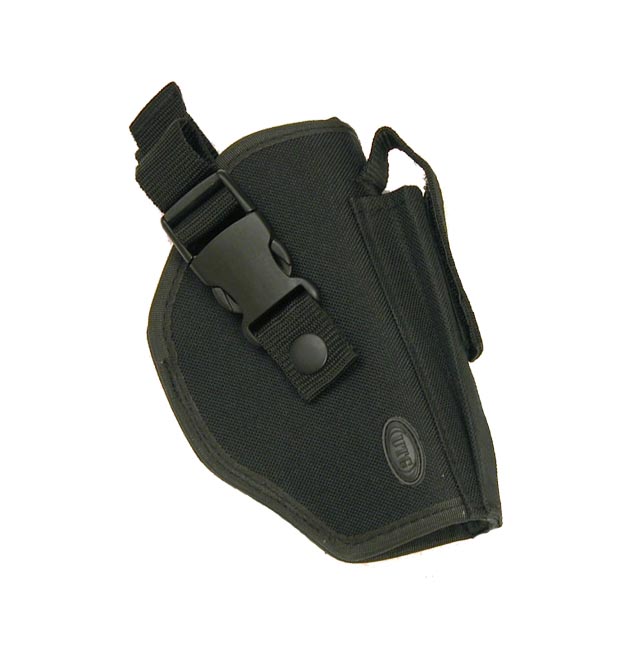
If you character is too cheap to bet his life on anything more than a .22 (and one known to have reliability problems), odds are he's got either a cheap nylon IWB holster or a simple belt loop:

pvch270b.jpg


or

e8e6_35.JPG


***
Just curious, though, how feasible is it for a guy with high-end home equipment and lots of skill to make a new slide out of steel or some other highly durable metal?
No problem at all of you've got a $2k mill and associated equipment ---- after thinking on that, a standard mill won't reach up in all the areas that need machining. You'll need some specialized equipment to do the milling on the slots down the side of the slide where it works on the rails....
 
Last edited:

DannyBoy2k

New member
So then, more questions...
- I couldn't see if this pistol could be bought without a threaded barrel. My character is, for the moment, from Mariposa CA, and I'm under the impression that threaded barrels installed on a pistol are considered illegal assault weapons. Does anyone know if this is possible?

CA law is, probably, the most restrictive in all of the US. As if works out, yes, it's considered an assault weapon of it has a threaded barrel. Can't figure why...fitting a silencer doesn't equal ASSAULT in my mind, but whatever...anyways, he'll have a problem with the threaded barrel. He CAN buy the gun in a private transfer. He may NOT buy the gun from a gun shop, OR from out of state. Basically, someone else bought it out of state, moved to CA, and sold it to him. OR, HE moved from out of state to CA, bringing the gun, potentially.

And thinking about it, it scares me that I know this....

evil tendencies said:
- Dragonsreach mentioned increasing the power of some of the rounds by increasing the powder charge. I know a little increase can be handled just fine, but at what point does the barrel on a smaller weapon like this need to be strengthened to handle the increase in pressure?


That is really a minor sort of problem. The barrel can handle the problem just fine, unless you REALLY overload, in which case you're more likely to crack the case of the round, or you fire a truly staggering amount of rounds through it. To give a general sort of mark, the GLOCK was tested when the polymer-framed guns made their appearance. They massively overloaded the rounds, and fired something in the neighbourhood of 50 THOUSAND rounds through it before fatigue started showing. And that was the slide rather than the barrel, too.

evil tendencies said:
- What kind of mods to the ammunition would be useful for normal concealed carry? I'm thinking that he wouldn't be concerned with defeating armor, so maybe using lead rounds with an added hollow point and extra powder? I know they aren't the best for the barrel, but he would likely figure that new barrels and more cleaning would be a small price to pay for a more effective weapon.


Well, a jacketed hollowpoint is ok from a 'cleanliness' standpoint. (Black) Talons, or a similar round, would be really good, but as I recall, they were never made in .22, not that a bit of careful work wouldn't make it possible to 'home-make' them. They might end up with sub-par ballistics, but the ranges we're likely talking about here, that wouldn't matter much. Not as if he'll snipe a guy three streets over. As I said above, a spoon-tip round would be very unpleasant, but again, availability in .22 is uncertain, and probably doubtful. Now, it should be possible to make those too, but that would require a bit more work than a Talon-type round. Glaser safety rounds look good on paper, but they tend to underpenetrate. The air marshals tested them when they came out and while they're certainly SAFE, defined as 'we don't put a hole in the plane'...they also don't go deep enough to be much use. So, in MY opinion, and like always, everyone have one, they stink and they're worth what you pay for'em, In order of 'best' to 'worst', not that worst is bad, a Spoon-tip round if you can find, or futz, one...some form of Talon round or 'relation', same with availability, and finally a copper-jacketed hollowpoint.
 

DannyBoy2k

New member
The p-22 is available without threaded barrel. Not a crime to own a threaded barrel, but it may not be legal in CA to sell one.

Unfortunately, no it's not. The barrel is threaded to accept a barrel nut. And as said, threaded barrels means 'assault weapon' under CA law.

The Assault Weapons Control Act of 1989 states that certain characteristics are a no-no, and among them:

4) A semiautomatic pistol that has the capacity to accept a detachable magazine and any one of the following:

* (A) A threaded barrel, capable of accepting a flash suppressor, forward handgrip, or silencer.
 

airhead

Coffin Dodger / Keymaster
did not realize that there was a threaded barrel under there...

as to modifying ammo....
1. careful unless you know what you are doing... drilling out or swage-ing a hollow point in a non-HP ammo, may reduce the bullet thickness in that area to the point that the bullet fails either in initial shoot or going down the barrel. The gases overcome the thin lead in that spot and blow out the bullet. Worst case, this leaves a bullet somewhere in the barrel - waiting on the next round to come down. Serious overpressure problems develop.

2. having to go into court for a 'clean' SD shoot with modified ammo and hearing the survivor's lawyer ask you something like this: "Mr. Tend, you didn't feel that the manufacturer's ammo was deadly enough and you had to make modifications to insure that you killed my client's husband, robbing her of her means of income now and in the future?"
 

DannyBoy2k

New member
2. having to go into court for a 'clean' SD shoot with modified ammo and hearing the survivor's lawyer ask you something like this: "Mr. Tend, you didn't feel that the manufacturer's ammo was deadly enough and you had to make modifications to insure that you killed my client's husband, robbing her of her means of income now and in the future?"

Answer being, 'Mr. Attorney, your clients husband was pointing an ASSAULT-RIFLE at me at the time in question. Given the choice of me shooting him with my small gun or him shooting me with his BIG, fully automatic gun, I can't really say that it breaks my heart. Not to mention that if that is how he got his income, wouldn't that make your client an accessory to a crime?'
 

Tercha

Member
modified ammo - drill out the point (slightly) add a drop of mercury and cover with candle wax (to keep the mercury in place).
 
Back To Top
Top