A writer needs some firearms info

DannyBoy2k

New member
Unfortunately, that doesn't work, for a number of reasons. If it had worked as advertised, then yes. But there it is. Of course, this IS a story, so authors license always work, but from a purely 'real' standpoint, no.
 

cassar

BALLSCRATCHER
tolerances

harking back to what danny2k said re glocks being tested with over powerd rounds that is indeed correct but there's more of a danger to a shooter from "weak" rounds than strong for example i was standing next to a guy on the range when "the weak round struck" the bullit head jammed in the barrel as the gasses werent strong enough to expell it, the gasses couldnt vent from the weapon in the normal manner and the barrel expanded in an alarming bulge which fortunatley prevented the slide from returning and chambering another round as the next one fired would undoubtedly have ended up causing a breach explosion, lucky bugger. there's also a distinctive sound to a weak round which a trained ear can pick up on.
correct me if im wrong buti think something like this happened to bruce lees son whilst filming the crow he wasnt so lucky.
dont mess with the rounds would be my advice.
 

DannyBoy2k

New member

Unfortunately not relevant, not in this case or really any other.

First, lead and mercury doesn't weigh the same. And mixing it with tin and/or antimony makes the situation WORSE, not better. Mercury is HEAVIER than lead, and liquid to boot, making a heavy weight move inside the bullet, causing the ballistic properties of the round go out the window. Now, in a .22 at a short range, that might be excusable, but there it is, certainly not something you want if you can avoid it.

Secondly, mercury is TOXIC. Very much so. You can get both cronic and acute mercury poisoning, from both direct contact and from inhalation. Very extensive apparatus is needed to handle it.

Third, mercury crystallizes and softens other metals it spends any time in contact with, thus increasing the likelyhood that the round will rupture in the chamber. At the very least, you have a feed-jam, and no more rounds coming. At the worst, you have a very unhappy hand and no more gun.


And, having read that forum-post you linked, I have to conclude that
A, they're talking of some form of mercury mixture, or
B, they never had basic chemistry in school.
Solid Mercury? Mercury is a liquid from minus 38 degrees F to about 675 degrees F.
 

airhead

Coffin Dodger / Keymaster
as a deadly round, mercury might be worthwhile to add. Lots of other things would do as well: cyanide, arsenic, rat poison, etc. So that if you only wounded him, he'd suffer long term debilitation or slow heavy metal death. Great in a spy novel.

In a self-defence shoot, your goal is to stop the attacker - not necessarily kill him. Adding poisons to your bullets could easily be interpreted as premeditated.
 

cassar

BALLSCRATCHER
airhead i dont think thats fair, shot, poisoned why not add a bayonnet and include stabbed as well lol. you could hollow out the tip then place a small piece of apple in it with some sugar on it when the persons shot with the round it would cause a massive localised infection. bring a little tuthe to the saying "how'd he die? lead poisoning...someone shot him":tongue:
 

cassar

BALLSCRATCHER
Your character should use a club or a knife like a real man :)


Or if he has to use a pistol use this one;
Rin32Spanish%20Miquelet%20pistol.jpg


If he is a very good shooter should be no probs!


you would have balls of steel to pull that monster on anyone lol
 

evil tendencies

Cake or Death?
did not realize that there was a threaded barrel under there...

as to modifying ammo....
1. careful unless you know what you are doing... drilling out or swage-ing a hollow point in a non-HP ammo, may reduce the bullet thickness in that area to the point that the bullet fails either in initial shoot or going down the barrel. The gases overcome the thin lead in that spot and blow out the bullet. Worst case, this leaves a bullet somewhere in the barrel - waiting on the next round to come down. Serious overpressure problems develop.

2. having to go into court for a 'clean' SD shoot with modified ammo and hearing the survivor's lawyer ask you something like this: "Mr. Tend, you didn't feel that the manufacturer's ammo was deadly enough and you had to make modifications to insure that you killed my client's husband, robbing her of her means of income now and in the future?"

First - the name Mr. Tend...I love it! So named!

Second, I think this is a very good point about modified ammo. It is just the kind of trouble that Tend (heh) would find himself in: having done something very legal and very pragmatic, he finds out that the public isn't always so willing to accept the necessities of dealing with Bad Men...cool.

Just curious, though, with a light round that would expand significantly, wouldn't the bullet be so malformed by the end that the original shape would be very hard to tell?
 

DannyBoy2k

New member
Just curious, though, with a light round that would expand significantly, wouldn't the bullet be so malformed by the end that the original shape would be very hard to tell?
No, not really. Since we are talking about potential legal follow-ups of a shooting here, most every crime lab fires enough rounds that they know how expansion would happen in a standard round. Fire 1000 rounds and you will find similarities in shape and (dis)form. Unless you modify the round EXTENSIVELY, in case the ABSENSE of commonly seen points would point towards something peculiar. In other words, there are a set number of common .22LR rounds. Of these, two thirds display X after being fired. One third displays Y. If your characters round displays X or Y, we know more or less what he fired. If, however, the round displays Q, then something is REALLY peculiar, and merits greater investigation and so we find strange marks, straight lines which DIDN'T come from metal tearing, but from some form of re-shaping the bullet, or whatever. Simplified, but...

Of course, not all bullets di become that malformed. The spoon-tip I refered to earlier don't. Instead, the tip of the bullet is shaped in such a way that it stays more or less intact(some shift will always occur), but instead is MADE to tumble end over end through the target and, horrifyingly as it sound, more or less 'chop' internal parts up.
 

cassar

BALLSCRATCHER
dodge the legal consequences.. with forensics today easier said than done you would need to be extremely fastidious in cleaning every part of the weapon system, shell cases take them with you if you have time, magazines no prints here either, no trace of a finger print or dna on the actual gun. thats why a common round fired from a common weapon thats easily disposable and obtainable would be desirable. a unique weapon's system's like a fingerprint hard to refute in a court of law, reasonable doubt's what you want not the pearl handled peacmaker full of silver bullits hanging around your neck like a noose lol..22's as common as muck and walther are a big brand, good choice happy days.

oh burn everything including footwear, watches jewelry just dont wear any. a really thorough wash ,dont forget to do behind your ears.

remember you only do something wrong if you're caught
 
Last edited:

Einion

New member
Just curious, though, with a light round that would expand significantly, wouldn't the bullet be so malformed by the end that the original shape would be very hard to tell?
I'd have to say maybe. A bullet can in theory break apart completely in the right circumstances (much more common with rifle rounds because of the much higher speed) but if a softer bullet impacts a bone inside the body its nose will be mashed unless it's going pretty slowly.

So the theorised velocity and the bullet material(s) would be important factors, as well as what they hit specifically (both in the body and clothing/personal items).

Einion
 

airhead

Coffin Dodger / Keymaster
Now, jugs of water, wet phone books, balistic gel, etc are not human bodies. Bullets do strange things in the human body - and .22's are one of the most notorious.

But here's what's left of a nice HP 22. after several water jugs:
19542b88.jpg


Plenty left for rifling comparisons.


***

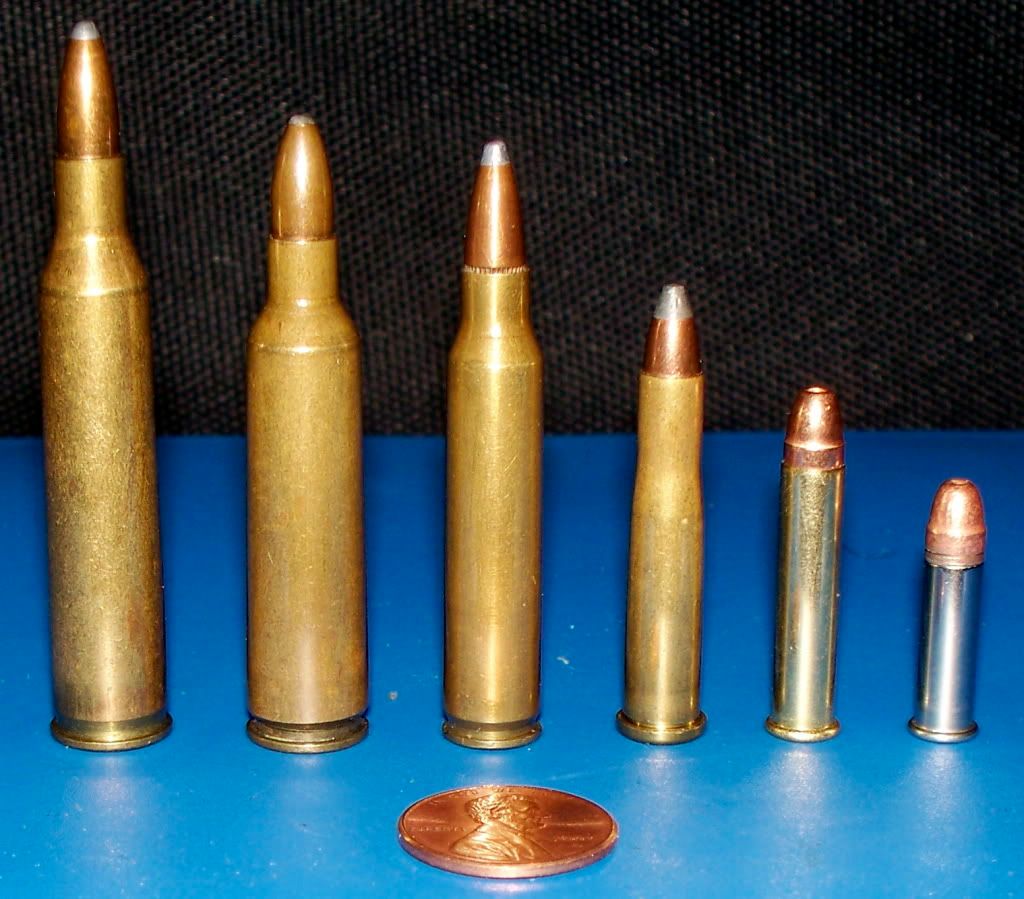
Mike, looked at that midway reloading kit. It is for the .22 Hornet. A centerfire weapon - way different than a rim-fired .22 LR.
100_0663.jpg

.220 Swift, .22-250, .223 Rem, .22 Hornet, .22 Magnum, .22 LR.
 
Last edited:

cassar

BALLSCRATCHER
nice collection of soft nose rounds are they modern? by that i mean does the jacket cover the base? some of the old rounds can shed the jacket in the barrel as they are open at both ends. what about drt rounds or frangible are they produced in .22? they are good value when they work lot of punch for the pound.
 
Being from Belfast im happy to say i know next to nothing about guns, bullets ect. Iv been reading contently but a .22 round CAN kill cant it. (im sorry northern ireland for letting you down )
 

airhead

Coffin Dodger / Keymaster
@Cassar, I've no idea. I simply googled .22 Hornet vs .22LR

@Master of Fact, the .22 LR is probably responsible for more deaths than any other round, accidental or intentional. Mostly due to the billions of them produced. Back when and where I grew up, everyone had a .22 pistol most had at least one and most had a .22 rifle as well.

As to choosing it for a self defense round, I wouldn't. Not much energy in that round. You are relying a lot on bullet placement and .22's are notorious for taking off in odd directions once they hit a body. Wild things like: Go in under the skin, go completely around the body and come out the other side. Go in the side and come out a leg - not from a down-angle shot.
 
Last edited:

DannyBoy2k

New member
Being from Belfast im happy to say i know next to nothing about guns, bullets ect. Iv been reading contently but a .22 round CAN kill cant it. (im sorry northern ireland for letting you down )

Oh, not only can but do. Now, a 'standard' .22 has a harder time going that than a .45 or a 9mm, but it all depends on shot placement. Any major blood vessel can cause you to bleed out quickly. If you shoot at short range, you can manage to penetrate the skull. Same if you can get through the ribs and into the heart. And, if you can hit the spinal cord, high up enough, you'll 'shut him down' as it were. No signal along the spine means nothing working underneath. So, if it is up by the neck, no signal goes to the lungs and heart.


As an ENTIRE aside, pointed at Evil Tendencies, do note that CA is one of the more restrictive states when it comes to concealed-carry. They practice 'May issue' in that you can only get the permit if you have a demonstrable NEED for it.
 
Back To Top
Top