War: pros and cons

chrismisterx

New member
Is War right or Wrong ?

To be honest I dont know, its such a complex question, we could talk about it for years...

History or His-story as I like to say it, have you all not noticed that history tends to be written by the winners of conficts, so we do tend to get a bais view.

Anyway my thoughts.....

Look back to the past, you will find many answers in history. Why is the middle east such a problem?

My view is its thanks to the UK, when we had empire we messed around with so many cultures around the world, it was insane, now if you compare the trouble hot spots with where we messed around with.... bingo you see a trend.

Iraq and Iran were one nation back before the first world war, the people there where on the whole content. It was the UK who split the nation up, it was the UK who first targeted the kurds and bombed them on mass. It was the UK who built the first concention camps, which was in the middle east.

Also look at India and pakistan we split that nation up aswell, and look its been a trouble spot ever since......

My point is No-One knows what affect us messing around in Iraq and Afghanistan is going to have long term.
My view was and is Sadham was not a good leader, but I dont think he was the worst either, theres wosre leaders out there that we ignore.

Is war right or wrong was the question, the germans thought it was right in the first and second world war, they thought they had the moral high ground.
But the allies won, so that made us right :) if the germans had won, history most likley would have stated that they where right, because it would have been written by them lol .....
Anyway rambling alittle.
Who fancy\'s a drink, my head hurts < hope I made alittle sense somewhere in there> :beer:
 

Ziggi

New member
Originally posted by Trevor
*Being part English and part Scottish with a bit of Irish thrown in for good measure means I get to hate myself :D

No, you get to hate the welsh....:p
Ziggi
 

the alleycat

New member
Originally posted by steelcult
Hmm -

Lets see can anyone tell me under what authority we did actually invade Iraq?

How about a UN resolution that called for the Iraqis to allow inspection of their WMD Sites, and the complete distruction of thier existing WMD stockpile.

Now the fact that he swore he destroyed all that stuff should have been good enough, right?

However, the 500+ Sarin Gas rounds that have been found over here kinda point to the fact that he didnt.

Make what arguments that you want that its an immoral war here folks, but we took an SOB who used Chemical Agents on his own people out of power.

So would it not have been more appropriate to let those people get rid of him? Of course it would have taken a while as after the first Gulf War most of the elements set to rebel were killed as they\'d shown themselves in the belief that they had western support.

That aside:

People say war is ok if you\'re defending your country etc. However, without someone else startuing some sort of violent conflict this wouldn\'t be needed in the first place.

War is bad. It is also an aspect of human nature so isn\'t going away anytime soon.
 

laurence

Brushlover
this and that

Originally posted by steelcult
Nothing personal Laurence -

It just bugs me when opinion is stated as fact, or statements are made with nothing to back them up - and I will, as is my right, disagree and put up the facts as I understand them.

If you want to change my view, show me the supporting evidence, not your feelings.

No worries Steelcult.

You\'ve made a fair call and a good point. No hard feelings.:)

Unfortunately for me I tend to let my emotions get the better of me at the best of times. I\'ll try to support my statements with a little fact in any future posts.

Also please don\'t take me the wrong way. I\'m not anti-American or anything like that. I just don\'t agree with war and it seems that the American nartion is always at war---that\'s all.
 

Ziggi

New member
What is war and is it right or wrong?

The question raised and debated here is quite complex. First thing we should do is differentiate between war as contunuation of (foreign) policy and the act of war in it self.

The act of war has its own laws entirely (not talking about the laws governing warfare, lets get back to those later). War has its own nature. It is the nature of war that all possible means should be used upon the enemy to destroy his ability to continue war. Anything else is not wise and against the the nature of war. This is not how war has always been understood by everybody (different forms of \"ritualistic\" war have existed through the ages), but this is the modern view. There are some things, however, that have been viewed as being outside the norms of civilised nations and their armies (the laws of warfare, mainly the Geneva conventions etc. limiting the use of force on the actual combatants etc.)

Back to the point. The nature of war dictates that usually war is generally unpleasant for all involved. The laws of warfare are meant to limit the sufferings, but in reality people do suffer during war time on massive scale.

Therefore we come to the philosophical question of the rightness or wrongness of war. In this context the political (or other, but in reality they are always mostly power politics) reasoning behind a war are important. Someone\'s \"good\" war can be someone else\'s \"bad\" war. Here the actual outcome of the war has a major impact. For example most people in US would rate the 1st Gulf War as good, since the outcome was a victory and the context of liberating Kuwait is seen a the right thing to do. The 2nd Gulf War will be judged years from now, but it seems to been going worse as it drags on and casualties accumulate (This being an outsiders view so dont start about this).

Is war an aspect of human nature? Who knows, but it seems that the people doing the fighting and killing are completely different from those making the decisions on starting a war. Power politics is surely a aspect of modern society and war will be used from time to time as long as the ability to do so exist for the politicians. The threshold of using war as a tool in international politics is inversly dependent on the ability to wage war. US, with arguably the best means to wage war, has in the resent history been quite prepared to do so. The only actual limitation is not in the ablities of US armed forces, but in the ability of the US general public to withstand a protracted war and the high casualty count it inevitably means.

Back to the point and lets try to conclude somthing. From ethical point of view war in it self is never a good thing, but the moral reasons for going on to fight a war might be. Here the most important thing is to separate the real fundamental reasons why a war is being fought. For someone defending their country it is fairly simple. But invading another country is always more complex as we can see from this debate and on how the issue has devided the US.

[/rant]
Ziggi
 

MPJ

New member
War is neither good nor bad, it just is.

War is a fact of life and a necessary part of human existance. I use \'necessary\' not because it does positive things but rather because it is part of us, as long as there have been humans gathering in groups larger than a family there has been war at some scale or another.

While it is true that civilians often have a rosy view of war which I\'m quite sure is totally incorrect, the fact is that not everyone who has experienced war has a dim or gloom view of it. Just like some people are \'born leaders\', \'born artists\', \'born whatevers\', etc... some are \'born for war\'.

What really pisses me off are persons in the military who complain about wars and fighting and such. While they may be the minority (hopefully, but I do know a few) they are the ones trying to use the military as a \'free ride\' to an income without meaningful work. For the purpose of the military is war, if the thought of war scares/disgusts/whatever you then stay the frig out of the military. Of course this doesn\'t quite apply if your country has an active draft, but not many of us live in a country like that now.

Being in the military is a job, much like other jobs. I\'ve often though it quite daft how quickly and easily the term \'hero\' gets thrown around, simply being in the military does not make one a \'hero\' as is so often implied, though being in the military during a war certainlly gives people a better chance to show their heroic qualities. Made me ill a few months ago watching a speach as one of our ships was heading to the Gulf where the speaker talked about how each and every person in the navy was a \'hero\' and I\'m thinking about my wife\'s friends\' tubby hubby who has been in the navy 4 years now with a \'high sea time\' position and has been at sea less than 2 months total. He also used some made up excuses to duck out on his deployment. Now that\'s real hero qualities.

For the NATO forces there is very little comparison of the Gulf Wars to other conflicts the various NATO countries have been involved in of the 20th century, in fact compared to WWI, WWII, Korea, Nam, and a few others it is barely fair to call the Gulf stuff \'war\'.

Anyway, that is part I of my typically controversial two-cents. There may or may not be a part II. :drunk:
 

vincegamer

Active member
Originally posted by Ziggi
It is the nature of war that all possible means should be used upon the enemy to destroy his ability to continue war. Anything else is not wise and against the the nature of war. This is not how war has always been understood by everybody (different forms of \"ritualistic\" war have existed through the ages), but this is the modern view.
I don\'t agree with this statement.
I believe that was the view of war in the first half of this century. I believe that is how WWI and WWII were fought. Those were wars on nations, where the goal was to bring the nation to its knees by any means necessary. Entire cities were flattened (Dresden?). Civilian populations were slaughtered. Those wars ended because the citizens of the embattled countries were so horrified and worn down by conflict they never wanted it again.

Our modern view of war is that it\'s something that should not involve citizens and somehow we think it can be won by only killing the soldiers and the politicians and leaving the majority of the country to go its merry way.
I think that\'s just stupid and suggests Orwellian fabricated conflict.
 

Sand Rat

New member
Actually Vince the concept that war is something to be fought between soldiers is pretty old - I know from some of the reading I have done that the Romans when fighting what they considered Civilized nations (as upposed to the Germanic Hordes of Eastern Europe) tried to limit the actual battlefield casualties to the actual armies and those attached - sieges (and I know someone is going to bring em up if I dont) were a different animal altogether - and even then the Romans tried to be as efficient as possible when seigeing major cities. Why? Well, if you kill off the non military classes/non soldier types there is no one there to work the land and tax the hell out of to pay for the war.
 

Disturbed1

New member
I\'ll share my views... take them as you will.

I have always favored the concept of overkill. Wars should be fought hard and fast. Beat your enemy as severely and quickly as possible. I personally have no problem with the use of chemical or nuclear weapons.
The concept of war with rules never made any sense to me.
If war is supposed to be civilized, then why not just settle disputes over a game of chess?

The fact remains, \"you get further with a kind word and a gun, than just a kind word.\"
 

MPJ

New member
Originally posted by vincegamer
I believe that was the view of war in the first half of this century. I believe that is how WWI and WWII were fought. Those were wars on nations, where the goal was to bring the nation to its knees by any means necessary. Entire cities were flattened (Dresden?). Civilian populations were slaughtered. Those wars ended because the citizens of the embattled countries were so horrified and worn down by conflict they never wanted it again.

I\'d have to say that if the citizens of the embattled countries were so horrified and worn down by conflict then why were the Germans (after WWI) ready to go again in only 21 years?

@ Disturbed: Dang, there are people in the world with similar views to me, I\'m surprised. Though I must protest the nuke thing a bit, more because of the retribution factor being so high rather than a moral stance against them.
 

vincegamer

Active member
Originally posted by steelcult
Actually Vince the concept that war is something to be fought between soldiers is pretty old -
Well, yes, that\'s correct. I called it a modern view, though perhaps that was misleading.
Perhaps WWI and WWII (I always class them together as I don\'t really think they were such separate conflicts as they were the same with a big cease fire in the middle) were an aberration from the traditional view of war. Perhaps the 30-years war marked the slide into civilian targets and we\'ve recently come back out of it.

So the point I wanted to debate, is can we win a war without crushing the civilian infrastructure?
 

funnymouth

Active member
Originally posted by vincegamer
So the point I wanted to debate, is can we win a war without crushing the civilian infrastructure?

not now. gurrila warfare/ terrorism is so prevelent and effective because of advancements in weapons (ordinance and small arms) that involvement of the civilian sector is inevitable. even more important is civillian involvement in millitary supply - they make the weapons and equipment, as well as the soldiers. crushing governments is one thing, but armies are fairly autonomous these days, for exactly that reason. nationalism plays a big part too. the more nationalistic a civilian group, the more difficult it is to disentangle them from the military. involving civilians is part of war, and frankly, its the crappy part.

@steelcult: i dont like your opinion that \"if you are a soldier you should be pro war.\" peacekeeping and non-combat support are also important responsabilities of the military. anyone is entitled to a political opinion, saying they shouldnt be against the war is similar to saying they should be mindless automatons. as much as the military might enjoy that, its only superficially a good idea; thinking soldiers are important. its crucuial that their personal opinions dont interefere with their job, but that is true for any career.
 

Disturbed1

New member
@MPJ - the retribution factor is certainly an issue. Nukes wouldn\'t be my first choice, but never take a viable option off of the table.

@Vince- interesting concept, leaving the civilian infrastructure intact. I\'m not sure it\'s possible. Look at Lebanon for example. Hezbollah\'s HQ in a civilian neighborhood. When opponents use civilians as meat shields, it\'s going to take extreme precision to remove the threats.
 

treide

New member
Most of the discussion has been about military action, but what about other forms of war. For example, \"economic war\" - sanctions against N. Korea, blockading the ports to Lebanon in the recent conflict, our President pulling the \"we can\'t let terrorists control Iraq\'s oil reserves\" card as a reason for staying the course. Do these strategies work? Are they any \"better\" than conventional warfare?

Also, what about religious wars? I agree with the comment made earlier about the UK wreaking havoc in the Middle East and elsewhere, but does anyone really believe that the Shiites and Sunnis would not be gleefully killing one another without Western involvement in the region? Take a look elsewhere - Darfur for example. Pakistan/India. The list goes on. As soon as you throw religion into the mix, you are going to have a motive for horrific, bloody battles with no end in sight.
 

Disturbed1

New member
Personally, I see economics and religion as the two major causes of war, I never saw them as wars unto themselves.
Your point is well taken though.

Even if you ban religion and money, we will find something to kill each other over.

I still say we should turn Iraq into 437,072 sq. km of day-glo kitty litter... just my 2 cents though.
 

Disturbed1

New member
Funnymouth, I made the kitty litter comment mostly in jest.

At this point, i\'m probably better off not saying much else. Further comments from me might result in banishment from the forums...and I actually like it here. :eek:
 

No Such Agency

New member
I\'ve stayed out of this discussion, it threatens to veer too close to similar ones on the web that have become quite unpleasant. But so far so good :)

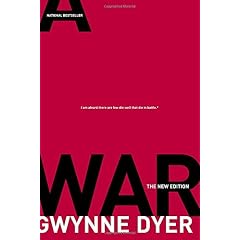
Anyone interested in the topic of how warfare has developed and changed over time should consider reading the book \"War\" by Gwynne Dyer. Originally published in 1985, it has been updated to consider the most recent two decades of post-Cold-War asymmetric conflict. He definitely has some interesting analysis of everything from tribal skirmishing, to the Phalanx, to the illusion of \"limited nuclear war\", and his style is highly readable.

0679313125.01._AA240_SCLZZZZZZZ_.jpg
 
Back To Top
Top